
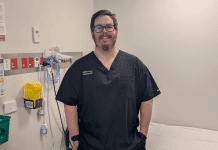


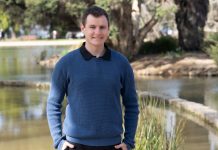



After a detour through nuclear medicine, Adam Livori carved out a career building cardiology services for rural Victorians.
Why choose pharmacy?
After year 12, I was working as an orderly at Northern Health, and received an offer to study medicine. But after seeing it through the eyes of an orderly, I realised medicine wasn’t for me. So I took my ‘gap year’ at Monash University in a biomedical science course.
I did a medical physics unit and found nuclear medicine fascinating, so I commenced a degree in nuclear medicine at RMIT. In my second year, I met a nuclear pharmacist, and after hearing about his career, I asked him at the end of the lecture what I needed to do to have his job. He told me to finish nuclear medicine and do a pharmacy degree – then we could talk about research assistant work at Peter MacCallum Cancer Centre.
I did just that, interning at Peter Mac before pursuing a research fellowship at Austin Health in nuclear pharmacy. While lab work was fun, the time I spent in contact with patients during my pharmacy degree was what I loved most. So I moved to Ballarat and started clinical pharmacy work.
How did you move into cardiology?
When I heard a cardiology project was being considered in the region, I wrote a paper outlining where pharmacists could add value. It led to my appointment as a project officer to get our cardiology clinics off the ground. We’ve since consulted over 1,600 people with myocardial infarction, atrial fibrillation (AF) or heart failure.
Around the same time, I completed a Master of Clinical Pharmacy in cardiology, publishing four papers that led to a PhD scholarship with Monash University and a $400,000 grant from Safer Care Victoria to expand into the AF clinic space. My PhD focused on biostatistics, epidemiology and health economics, which I now apply to large national datasets and local intervention projects.
What’s a typical day as a lead cardiology pharmacist?
It’s a mix of clinical, research and implementation work. In my clinical role, I work in the rapid access AF clinic with a physician. I’ve developed a model where telephone consults are used to educate patients on AF, undertake medication interviews, and order relevant screening tests like echocardiograms, Holter monitors and pathology. My medical imaging background helps with reading images and reports, and understanding test requirements. I also see patients face-to-face – taking ECGs and lung auscultation, examinations and AF care planning.
On other days, my work is about seeing gaps and opportunities in patient care, and working out methods to optimise pharmacist roles to address them. Recent examples include new governance for pharmacists to order pathology tests, rather than paging intern doctors to ask for them. I also lead research projects, with a recent study being the external validation of a readmission risk prediction equation.
What keeps you motivated?
I find joy in discovering new things and in helping others do the same – whether it’s a pharmacist working through a new clinical situation or a patient learning to manage their own medicines. About 2 years ago, I felt stuck – not finding much joy in what I was doing. So I came up with the ‘cool rule’: if I’m not working on something I think is cool, or with cool people, I don’t engage.
I spent a lot of my career chasing titles and grading rather than experiences and collaborators. With some great mentors and a lot of self-reflection, I’ve been so much happier in my work and perception of my own worth ever since.
What’s next in cardiology?
It’s hard to talk about change without acknowledging AI. I see real opportunity in AI scribes, image analysis and self-learning risk prediction models to help streamline care. That said, these tools also risk deepening health inequity, getting caught up in predatory corporate billing and outpacing organisations with low technology and data-literacy.
Integrated data systems that show real-time cardiovascular risk across geographic and sociodemographic areas could help turn clinical trial outcomes into real results for our communities.
Pharmacists have a big role to play here, and I hope we can work with other healthcare sectors to put patient-centred outcomes first, rather than profession- or health-service-centred success stories.
Day in the life of Adam Livori, Lead Pharmacist in Cardiology, Grampians Health, Ballarat, Victoria
| 7:00am | Morning send-off
Make breakfast, pack a lunchbox for my daughter Rosie and get her ready for kinder. |
| 8:00am | Start the day
Get to work. If I’m in my clinical role, I see patients on ward rounds, or prep clinics and triage referrals. |
| 10:00am | Team catch up
Coffee with work mates is a highlight of the day. Then I’m either back to the clinic or in research mode, where I plan out analyses and reviews of papers and protocols, or attend the occasional research team meeting. |
| 1:00pm –3:00pm |
Video visits On clinic days, I see three patients via telehealth. I discuss their heart health, going through recent test results and procedures, and what this means. We also discuss any medicines-related issues, and I’ll write up a letter for the cardiologist. |
| 3:00pm – 5:00pm |
In-patient exams I usually see 5-6 patients in person for a cardiovascular assessment. I perform blood pressure and heart rate checks, palpate their pulse, perform lung auscultation and check for fluid overload in their legs, then perform an ECG and review. Letters are also written up for these patients and sent through to the cardiologist. |
| 5:00pm | School run
Ideally leave on time and get to kinder to pick up my daughter. |
| 6:00pm | Lift, then chill
I do powerlifting and strongman training 3–4 times a week, getting back in time for bedtime stories. I then sit down and watch some TV with my wife, Bec – currently House of the Dragon and a Yellowstone rewatch — then go through the reels we’ve sent each other during the day. |