







From 1 October 2026, COVID-19 vaccination will move from its pandemic-era funding model onto the National Immunisation Program Vaccinations in Pharmacy (NIPVIP) program, alongside a new private pathway for patients who fall outside the eligibility for a funded vaccine.
With almost a month to go until the transition, PSA’s Inaugural Vaccination Ambassador Anna Theophilos MPS told AP that pharmacists need to begin preparations now.
‘If we can do the groundwork in September, it will make the transition so much easier,’ she said.
Here’s what needs to be done, and when.
What’s changing this week?
Pharmacists have until 28 August 2026 to place their final order through the COVID-19 Vaccine Administration System (CVAS), with stock expected to be delivered by 11 September.
‘What pharmacies have been asked to do is place an order that’s going to cover them for all of September and into October – and you should order enough stock for 4–6 weeks,’ Ms Theophilos said.
‘Because even though the first NIP order can be placed from 1 October, it could be 7–10 days before it is received.’
What happens to leftover CVCP stock?
Existing COVID-19 stock doesn’t need to be returned. ‘Whatever excess stock you’ve got just transfers across to NIP stock,’ Ms Theophilos said.
Pharmacies must continue submitting eligible COVID-19 vaccinations as COVID-19 Vaccinations in Community Pharmacy (CVCP) claims through the Pharmacy Programs Administration Portal until the program closes – with a final CVCP report due by 25 September.
CVAS ordering and allocation will be switched off from 1 October, so that report – and reconciling existing stock against it – needs to happen before the cut-off.
When can pharmacists order NIP-funded and private stock?
NIP-funded COVID-19 vaccines can be ordered from 1 October through each pharmacy’s usual state or territory NIP ordering system. Private stock will need to be ordered separately through wholesalers.
Stock management processes should be updated now so NIP-funded and privately purchased stock – and ideally fridge locations – are clearly distinguished.
How will the change affect pharmacy workflow?
Pharmacy currently delivers more than 40% of Australia’s COVID-19 vaccinations, but Ms Theophilos believes if pharmacies prepare their teams and community well, it shouldn’t upend day-to-day operations.
‘From my experience, pharmacies already carry much of the conversation around COVID-19 vaccination within their local communities, so it’s only natural that patients will turn to us as trusted health professionals to help them understand and navigate these changes,’ she said.
‘’Workflow-wise, a key change is about being more intentional with who we’re having these conversations with. We’re moving away from COVID-19 vaccination being universally funded, so pharmacies will need to proactively identify patients who remain eligible for funded vaccination, while also recognising those who may benefit from vaccination based on their individual risk.
‘That means making COVID-19 vaccination part of the conversations we’re already having, particularly with older adults and people with underlying medical conditions, rather than waiting for patients to ask us about it.’
How should pharmacists brief their team?
A whole-of-team briefing in early September is essential, Ms Theophilos said.
‘It’s important to make sure all of your team is aware of the changes and the eligibility, because it’s usually not the pharmacist who’s answering the phone,’ she said.
Staff should understand who the COVID-19 vaccine is funded for, who it’s recommended for, and who can still access it privately – and be able to explain why.
‘[For example], “We’ve gone from a universal program to targeting groups that have got the highest burden of disease. If you fall into that, then it’s recommended that you get a vaccine”.’
How can pharmacists prepare patients before go-live?
Pharmacists should start by identifying which patients will fall outside the funded cohorts once NIPVIP eligibility narrows. From there, send patient communications in the first week of September so patients have time to act before the cut-off, and start conversations with anyone who might be due for a COVID-19 vaccine while it’s still funded.
At every dispensing encounter, Ms Theophilos’ team has been asking patients: ‘Where are you up to with your COVID-19 vaccination journey?’
‘Then I’ll say, “The reason we’re asking is because COVID-19 vaccination is no longer going to be universally funded, so we’re just making sure the community is aware of that”.’
Booking systems should also reflect NIP and private options from mid-September at the latest, and anyone already booked in for an October COVID-19 vaccine should be contacted so they aren’t caught out.
‘You don’t want a patient to turn up and say “well, I booked for a vaccination on 3 October, and if I’d come in on 30 of September, it would have been free”,’ she said.
In Ms Theophilos’ experience, these early conversations have increased vaccine uptake.
‘People who haven’t been vaccinated against COVID-19 in years since their primary triple dose have said, “Yes, absolutely, I’ll get my booster”.’
Where can pharmacists find more information?
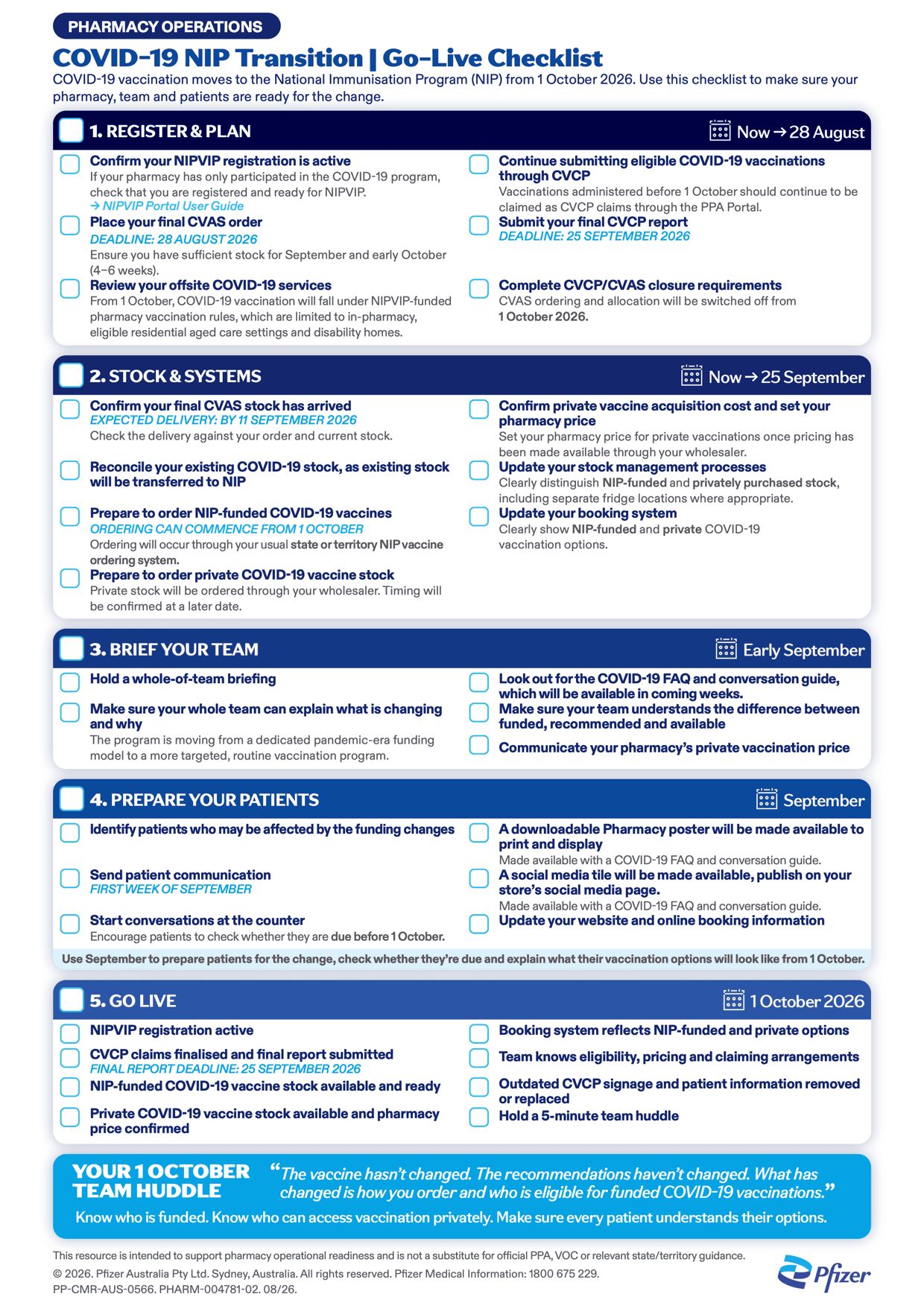
Ms Theophilos has been working behind the scenes to pull the transition’s moving parts into one resource. The COVID-19 NIP Transition Go-Live Checklist (above) gives pharmacists a single document to work from, rather than piecing the transition together themselves.
AP will also provide further updates over the coming weeks.