







With some GPs booked out for weeks, this regional pharmacist says prescribing could help her community get care faster.
When Lisa Gibson MPS decided to train as a pharmacist prescriber, she knew she might have to wait before putting her new qualification to use.
Ms Gibson, proprietor of Orana Mall Pharmacy in Dubbo, NSW, was among the first cohort of PSA trained pharmacist prescribers.
‘The self-paced, flexible [nature] of the PSA course and the option to do everything outside of [working] hours was what attracted me to it,’ she said.
Building on existing knowledge
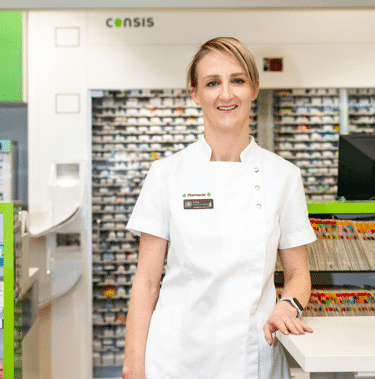
The PSA course is not about starting from scratch, Ms Gibson said. Instead, it helps pharmacists build on foundational knowledge and understand how to apply it within a safe prescribing framework.
This includes use of AI-enabled simulated patient consultations for each condition.
‘You get a scenario of a patient with a condition, and you’ve basically got to treat them how you would in the real world,’ she said.
‘You’re assessed against a criteria… it marks the questions you didn’t ask, it gives you a breakdown of how you would have gone in an examination, and that flows onto how you would have met the needs of the patient in the real world.’
One particularly valuable component was the prescribing mentorship. Ms Gibson worked with an emergency doctor, completing six cases under supervision and receiving feedback on her approach.
Her mentor saw a clear role for pharmacists in easing pressure on emergency departments, Ms Gibson said.
‘They want to save emergency doctors for emergencies, life-threatening conditions and illnesses, and a lot of the things they are seeing are conditions which we can safely treat in community pharmacy.’
It’s a pressure Ms Gibson sees in her own community, where she said the benefits of pharmacists practising at full scope would be huge.
‘In our region, some GPs have a 6–8 week wait list,’ she said. ‘And there’s only a handful of same day appointments if you are acutely unwell.
‘[With pharmacist prescribing], hopefully we’ll be able to have a closer working relationship [with doctors] and work together to see our patients sooner and faster.’
Asking better questions
Ms Gibson said PSA’s prescribing course has already changed how she approaches patients – particularly the questions she asks.
‘The course really focuses on safety-netting and gets you to think about what else a patient’s symptoms could be,’ she said.
‘It takes things to a deeper level. In community pharmacy, we tend to ask enough questions to know where to refer patients because we can’t treat them ourselves. Now, it’s about asking enough questions to understand whether we can actually help them.’
Knowing when to refer remains an essential part of safe practice. But Ms Gibson believes the training will help pharmacists make better-informed decisions about the care they can provide.
She and her team have also begun talking to patients about the services they plan to offer in the future.
‘We just want to get as many pharmacists as we can trained up, because there are so many patients we see that we [could] help,’ Ms Gibson said.
An investment in your practice
Ms Gibson sees prescribing to full scope as the next stage in a broader shift in community pharmacy.
‘Pharmacists proved they can upskill and do different things when we were given the opportunity to vaccinate,’ she said. ‘Trust in the profession [has] continued to build after that, and pharmacists are enjoying the variety of work as well.’
Ms Gibson isn’t alone in seeing the value. PSA Queensland Branch Committee member Emma Conway MPS, one of the program’s first graduates, encourages other pharmacists to take the step.
‘This opportunity simply highlights the ability for organisations such as the PSA to deliver high-quality training, upskilling and mobilising a workforce,’ Ms Conway said. ‘If you are on the fence, know that if I can do it, there is nothing stopping you.’
Ms Gibson advises pharmacists considering the training to see it as an investment in their future practice and an opportunity to improve patient care.
‘This is the next step in our healthcare journey and what we can offer,’ she said.
‘It’s professionally rewarding, it’s good for our community and it’s good for the patients – we can safely help them, and also have the skills to know when we need to refer.’
Keen to become a pharmacist prescriber? Click here to find out how.