







Salbutamol on its own is no longer recommended for adults and adolescents with asthma, but has its role in chronic obstructive pulmonary disease (COPD) changed?
In September 2025, the Australian Asthma Handbook stopped recommending as-needed short-acting beta2 agonist (SABA) as a standalone therapy for adults and adolescents over 12 years of age with asthma. Inhaled corticosteroids (ICS) are now indicated for all adults and adolescents.
SABA-only treatment and overuse in asthma is associated with a higher risk of severe asthma exacerbations. With so much focus on SABA overuse in asthma, is there a risk every request for salbutamol is viewed through this lens?
As World COPD Day falls today (18 November), AP explores how pharmacists can tailor a SABA consultation for patients with COPD.
Why shouldn’t pharmacists assume every salbutamol request is for asthma?
Salbutamol’s current Schedule 3 entry covers people presenting with bronchospasm associated with asthma or COPD.
The first step is to work out what the person is using salbutamol for, said Queensland-based community pharmacist and pharmacist prescriber Amy Smith MPS.
‘[It’s about] determining if they’ve previously had a diagnosis of asthma, COPD or some other airway condition, and what their current treatment plan is with their doctor.’
How is SABA used in COPD?
While salbutamol relieves symptoms in asthma, it doesn’t treat the underlying condition and inflammation like ICS do, Ms Smith said. ‘It’s basically a band-aid.’
However, COPD is managed differently.
Under the COPD-X Plan, the Australian and New Zealand clinical guideline for the diagnosis and management of COPD, pharmacological treatment is built around:
- bronchodilators such as short-acting relievers (either a SABA, such as salbutamol, or a short-acting muscarinic antagonist [SAMA], such as ipratropium)
- long-acting muscarinic antagonists (LAMAs)
- long-acting beta2 agonists (LABAs).
Short-acting relievers are used if needed for acute symptoms, and ICS are used only in certain situations (considering exacerbation history) or when there is coexisting asthma or features of asthma.
‘If someone’s got COPD and they’ve got a good action plan, then there’s not necessarily a problem in using salbutamol in those patients, especially if they’re being treated correctly,’ Ms Smith said.
What should pharmacists ask first?
When a patient requests salbutamol, Ms Smith asks questions such as:
- Have you previously been diagnosed with asthma, COPD or another airway condition?
- What are your symptoms and triggers?
- What symptoms do you experience when you need to use salbutamol?
- Do you smoke, or are you exposed to second-hand smoke?
- Do you have any other medical conditions, or take any regular medicines?
- What’s your current treatment plan with your doctor?
For people without a diagnosis, Ms Smith listens for COPD symptoms, such as, ‘sputum, increased or persistent cough and shortness of breath [particularly] when walking’.
How can a salbutamol request uncover COPD?
For Ms Smith, a routine salbutamol request has led to a COPD diagnosis. The patient, aged 56 and previously diagnosed with asthma, presented with constant salbutamol use. They had also been a heavy smoker since the age of 16, became breathless during the physical demands of their job, and regularly experienced a cough and sputum production.
Ms Smith also asked about a history of chest infections, exposure to smoke as a child, and fumes or dust at work.
‘That said to me that it could be something more than just asthma,’ she added.
The Lung Foundation’s COPD-X Handbook discusses symptoms and risk factors which are considered as part of a COPD diagnosis, however, ‘You then need to refer them on to get proper spirometry’, she said, as this is required for a diagnosis.
Ms Smith booked the patient an appointment with their GP, who discussed smoking cessation before referring them for spirometry, and the patient was diagnosed with mild COPD.
What does a person’s SABA use tell us about their COPD?
In asthma, how often someone uses their reliever is a key question when assessing symptom control. In COPD, severity is assessed differently, with the COPD Assessment Test (CAT) measuring severity based on symptoms, Ms Smith said.
‘This includes cough, sputum, how much it affects their day-to-day life, and confidence leaving the house – rather than how much salbutamol they’re using.’
Lung Foundation Australia’s COPD Action Plan lists being more breathless than usual and using more reliever medication as signs of a flare-up – with increased reliever use part of the plan.
Its COPD Exacerbation Algorithm for primary care, designed to be used alongside the COPD action plan, advises salbutamol 100 microgram, up to 8 actuations (one at a time) via pMDI with spacer, repeated as required up to every 3–4 hours (as an option for a COPD reliever). A flare-up should also prompt a review by the patient’s GP, with consideration as to how to best manage their COPD moving forward.
What if it’s asthma and COPD?
Some adults have features of both asthma and COPD, known as ‘co-existing asthma–COPD’.
The National Asthma Council’s (NAC) Australian Asthma Handbook advises that management of patients with a diagnosis of co-existing asthma and COPD should mainly follow recommendations for asthma, rather than COPD; it is recommended that specialist review be considered. Importantly, long-acting bronchodilators without an ICS should not be used in people with any features of asthma, or with a history of asthma.
For patients with chronic respiratory symptoms, such as breathlessness, cough, chest tightness or wheeze, Queensland Health’s clinical protocol for pharmacist management of COPD (as part of Queensland’s COPD Monitoring Program in Community Pharmacy) suggests the following features to assist in distinguishing between the conditions as follows:
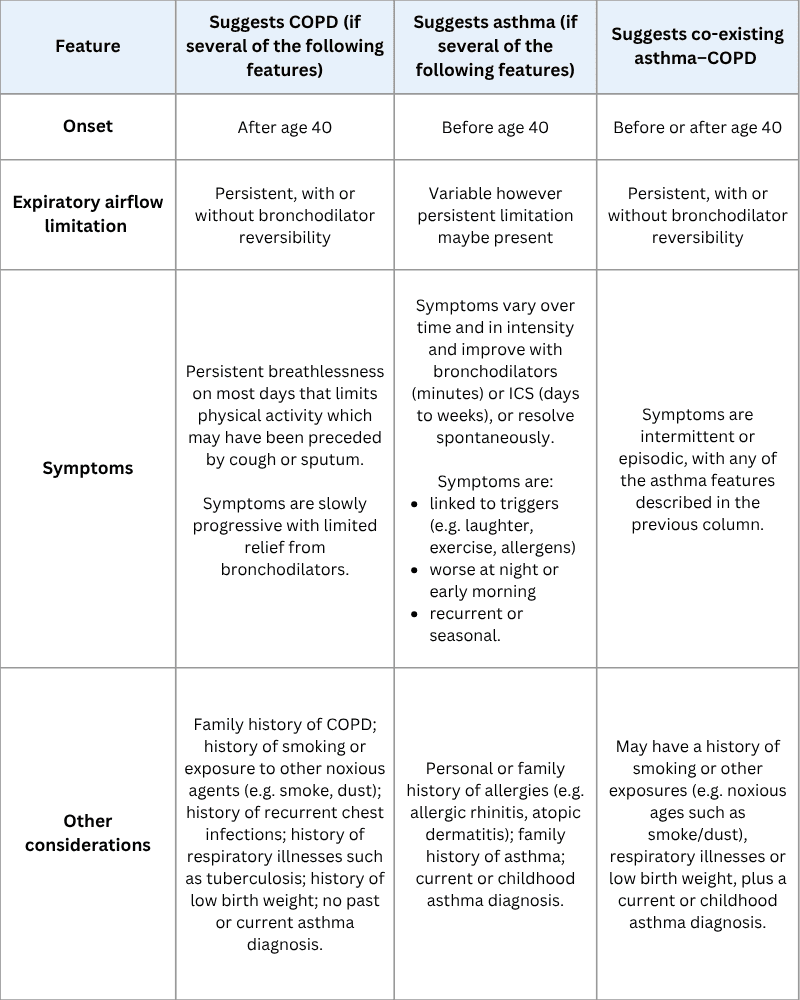
Ms Smith’s patient now has both conditions (‘co-existing asthma–COPD’), with a COPD Action Plan from their GP.
‘They’re still using the salbutamol for COPD, but we also need to make sure we’re treating the asthma correctly,’ she said.
What can prescribing pharmacists do?
For patients with a COPD diagnosis, prescribing pharmacists work collaboratively with the patient’s GP, Ms Smith said.
What pharmacists can prescribe or do depends on their state or territory’s regulations. For example, if a CAT assessment shows a patient’s symptoms are not controlled with SABA alone, a prescribing pharmacist may be able to step them up to a regular LAMA or LABA, if they meet the criteria as per relevant clinical guidelines.
Non-pharmacological care matters just as much.
‘It’s important to talk to them about continuing physical activity and ensure they have a COPD action plan,’ she said.
While COPD can’t be reversed, progression can be slowed.
‘The number one thing for this patient was to stop smoking; if you stop smoking, you can delay the progression of COPD quite a bit,’ Ms Smith added.
Career toolkit
Brush up on respiratory care with these AP resources:
- Earn CPD credits by completing Time to vent: changes to asthma management in adults and adolescents
- Catch up on the NAC’s new asthma guidelines.