
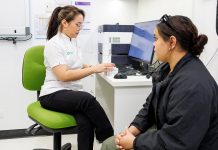






In the Barossa Valley, Travis Schiller FPS shows aged care is about teamwork, trust and better outcomes for residents.
What’s it like working as a pharmacist in the Barossa?
While only an hour or so from the city, the Barossa has all the advantages of a regional location.
It’s a privilege to serve in a community with such a rich history; the people and
the community embrace you and appreciate all you can do for them. When I first moved there, I was very quickly invited to present at service clubs and assist with local health programs.
There’s such a diversity of opportunity and organisations in the area willing
to explore new ways to improve care for the community. I was fortunate to have the support of local residential aged care facilities (RACFs) to explore new ways of supporting their staff and residents and improving medicines-related outcomes.
How did you get your start in aged care?
I developed a passion for it through my honours project on Residential Medication Management Reviews (RMMRs) post-hospital discharge.
I was fortunate to be involved in further projects, and with the support of a local facility, began spending regular time there in 2013.
I was not only interested in the on-site function but how a supply pharmacy and RACF could work together to achieve the best outcomes for residents – where pharmacy staff became part of the team rather than external contractors.
I was also fortunate to be involved in the initial Aged Care On-Site Pharmacist (ACOP) trials, and later assisted in a mentoring program where three privately funded pharmacists worked on site in aged care before the government-funded program rolled out.
Creating a mentoring environment allowed us to combine the benefits of experience in aged care with the enthusiasm, skill and knowledge of the next generation of pharmacists.
Working with independent RACFs meant we could act as the glue that helped them support one another locally, which we facilitated through regional Medication Advisory Committees.
What are the challenges of being embedded in aged care?
The ‘us and them’ mentality I had seen in many sites was the biggest challenge, with rigorous incident reporting leaving supply pharmacies as easy scapegoats.
Reinforcing to facility staff that I was there to assist them, that we were one team, and that our purpose was the residents’ benefit led to a culture shift and better outcomes. Up until the government funded the ACOP measure, funding was always an issue; and the current levels of funded remuneration will continue to be a barrier to the best and brightest taking up and staying in these roles.
What advice do you have for ECPs?
It’s often said that pharmacy is at a crossroads. While this sentiment is generally considered negative, I think it’s a great analogy for the exciting opportunities and options available to those starting out their careers.
There are many roads to travel professionally. When it’s time for a change, take a different route – explore, find what you love and do it. If it doesn’t exist as a career path, create it.
Get involved in the industry through conferences, organisations and networks – and definitely find a mentor, or a few. There are so many great people willing to share their time and knowledge, so don’t be afraid to tap into it.
Where do you see the pharmacy profession evolving?
With increasing role diversity, broader scope and rapid advances in technology, it’s an exciting time to be a pharmacist.
I’d love to see us truly recognised and valued as integral members of the broader healthcare system for all that we do.
I can only see our roles expanding as the population ages, with more specialised positions becoming the norm. Ageing at home will be the next big challenge – and we need to work out how best to support our communities through it.
A day in the life of Travis Schiller FPS, pharmacist owner, Nuriootpa, Barossa Valley, South Australia.
| 7.30 am | Prepare for the day Quick check of emails, paperwork and messages for staffing issues for the day ahead. |
| 8.30 am | Medication advisory meeting Catch up with aged care staff, GPs and the aged care on-site pharmacist. Discuss a recent issue with completing drugs of dependence recording systems and improve procedures to prevent recurrences. Talk about residents removing patches. Also discuss alternate therapies, alternate patch placement and improved surveillance. |
| 10.00 am | In the mall Visit our ‘The Barossa Pharmacist In the Mall’ pharmacy, touch base with rostering coordinator, check in with staff and see if the dispensary needs anything. Check prescriptions in the dispensary and counsel patients. Administer two COVID-19 vaccinations, and consult with other patients on hay fever and skincare treatment options. |
| 12.00 pm | In the main street Visit our nearby sister site, ‘The Barossa Pharmacist In the Main Street’, check with staff and provide lunch cover in the dispensary. Packing client arrives with a change to medicines, so organise the profile change and adjust packs. Warfarin commenced for one of our regulars. Sat with them and discussed the new medicine and their concerns. Receive a prescription for a packing client that doesn’t match profile; phone the GP to clarify. |
| 2.00 pm | Aged care supply and training Assist in the pharmacy with regular daily non-packed aged care orders for the afternoon, checking medication profiles and chart changes from the GP round. Also work through a Certificate III module with a pharmacy assistant after their S2/S3s schedules training. |
| 6.00 pm | Evening meeting Attend the local Health Care Advisory Committee meeting to discuss opportunities to fund facilities for our local hospitals. |
| 7.30 pm | Home time Hopefully make it home in time to say goodnight to my three girls, then relax and review the day with my wife. |