







Support is growing for Australian women who are or will be burdened by menopause symptoms. But a 20-year pause in conversations will take time to address.
In 2002, Sydney-based menopause specialist Professor Rod Baber was asked to go on ABC Radio after the release of the US Women’s Health Initiative (WHI), a landmark trial of menopausal hormone therapy (MHT) to treat symptoms involving more than 27,000 postmenopausal women aged 50–79.
‘When I got on to the radio live, I realised immediately that the discussion was about breast cancer, and they just said, “Women will die if they continue taking hormones”,’ recalls Prof Baber, a former president of both the Australasian and International Menopause Societies.
Alarm centred on a finding that combined estrogen-progestogen therapy increased breast cancer risk from 1 to 1.24 – equating to eight additional cases per 10,000 women each year.¹
The relative 24% increase in risk sounded scary, Prof Baber says, with the message obscuring the distinction made between relative and absolute risk, hormone formulation, age at initiation or the estrogen-only arm of the study. Relative risk of coronary heart disease, stroke and pulmonary embolism were also found to be slightly elevated, while colorectal cancer and hip fracture risk decreased, creating a nuanced risk profile.
The fallout of risk-focused reporting, Prof Baber says, was a generation of clinicians never taught menopause care ‘because it was perceived to be a dead end and a dangerous practice’. Medicines information pharmacist and academic Dr Treasure McGuire says pharmacists were no exception: ‘During a long period of uncertainty, we stopped educating about menopause. As health professionals became less confident, they stopped initiating conversations. [Menopause] was often framed as “natural”, and so women often thought they just had to put up with it.’
Two decades of follow-up have added important detail to the 2002 verdict on MHT and support the seeking of individualised answers. ‘It was a fantastic trial,’ Prof Baber says, but it was based on women with an average age of 63, long past menopause onset. ‘If you looked at the women who were most likely to initiate therapy – that is, women in their 50s – most of the harms were small, and most of the benefits were significant.’
Follow-up data published in 2017 showed a more favourable all-cause mortality profile for women aged 50–59 at randomisation.² Higher risk is now more commonly associated with late MHT initiation, beyond a decade after menopause.
Newer, body-identical hormones – oestradiol and micronised progesterone – also come with lower clot, breast cancer and cardiovascular risks than the synthetic formulations tested in the WHI. While delivering estrogen through the skin, via patches or gels, they avoid first-pass liver metabolism, lowering the risk of blood clots.
Evidence is also building behind the idea that MHT for women experiencing early menopause is protective in some cases, with an Australian-led international menopause and fertility study of 300,000 women, InterLACE, demonstrating that untreated early menopause markedly increases long-term heart and fracture risk.³ This has informed guidance in both Europe and Australia to offer MHT to these women unless contraindicated.
Hormone hill climb
Global responses to changing MHT evidence have been uneven. In the US, the FDA introduced black-box warnings in 2003 – only to largely unwind them in 2025, conceding they overstated risk, especially for women under 60 or within 10 years of menopause. In the UK, advocacy and cheaper prescriptions drove a 47% surge in public-sector MHT use in 2022–23.⁴ In Australia, MHT use dropped after 2002 and plateaued, barely shifting between 2014 and 2023 – increasing marginally from 9.05% to 9.74% per 100 women.⁵
This is despite substantial evidence that in Australia, menopausal symptoms are widespread and often debilitating. An estimated 74% of Australian women aged 45–55⁶ experience menopausal symptoms, with 17% reporting the need to take extended leave from work due to symptom severity.⁷
Evidence from the 2025 Australian Women’s Midlife Years (AMY) study, led by Professor Susan Davis at the Monash University Women’s Health Research Program, found that about 40% of women in late perimenopause experience moderate to severe vasomotor symptoms, such as hot flushes and night sweats. Yet only about 9% of the 8,000 women aged 40–69 surveyed used MHT to address these symptoms.8
The AMY study also identified structural gaps in care, such as the fact that current diagnostic frameworks and clinical guidelines are largely focused on postmenopause, leaving many symptomatic perimenopausal women unrecognised and without clearly endorsed treatment pathways.
Australian women are also staying in work through midlife in record numbers, and the economic and social cost of menopause is mounting, says Sarah White, CEO of government-funded education and information body Jean Hailes for Women’s Health. At the same time, difficult experiences of misdiagnosis and barriers to treatment – amplified by women sharing information online – are helping to create a tipping point, she notes.
That pressure alongside advocacy prompted a 2023–24 federal inquiry that received more than 300 submissions wofrom women describing debilitating menopause symptoms, ranging from hot flushes, sleep disruption, fatigue, anxiety and mood changes, to cognitive brain fog, heavy or irregular bleeding, vaginal and urinary symptoms, reduced libido and sexual discomfort, joint pain, and changes to weight, skin and hair.9
Women told the inquiry their symptoms were routinely missed or misattributed and that they were prescribed antidepressants instead of hormone therapy, referred for cardiac investigations, or dismissed as too young, too old or too high-risk for treatment (see case study on page 23).9
A subsequent report found menopause education was strikingly limited, with some medical graduates receiving as little as 1 hour across their entire degree. The downstream effect is a severe skills bottleneck: among more than 38,000 GPs and 1,700 gynaecologists nationwide, just 877 are members of the Australasian Menopause Society – reflecting the limited competence and training available in this area – while the handful of GP-led menopause clinics report unprecedented demand and months-long waiting lists.9
Clinicians said time pressures compound the problem. As Australasian Menopause Society president Dr Christina Jang told the inquiry: ‘We can’t do menopause in a 15-minute consultation’. Yet Medicare’s fee structure rewards exactly that. The result, the inquiry concluded, is fragmented care, delayed diagnosis and a widening quality gap that falls hardest in rural and regional areas where clinician time is stretched.15
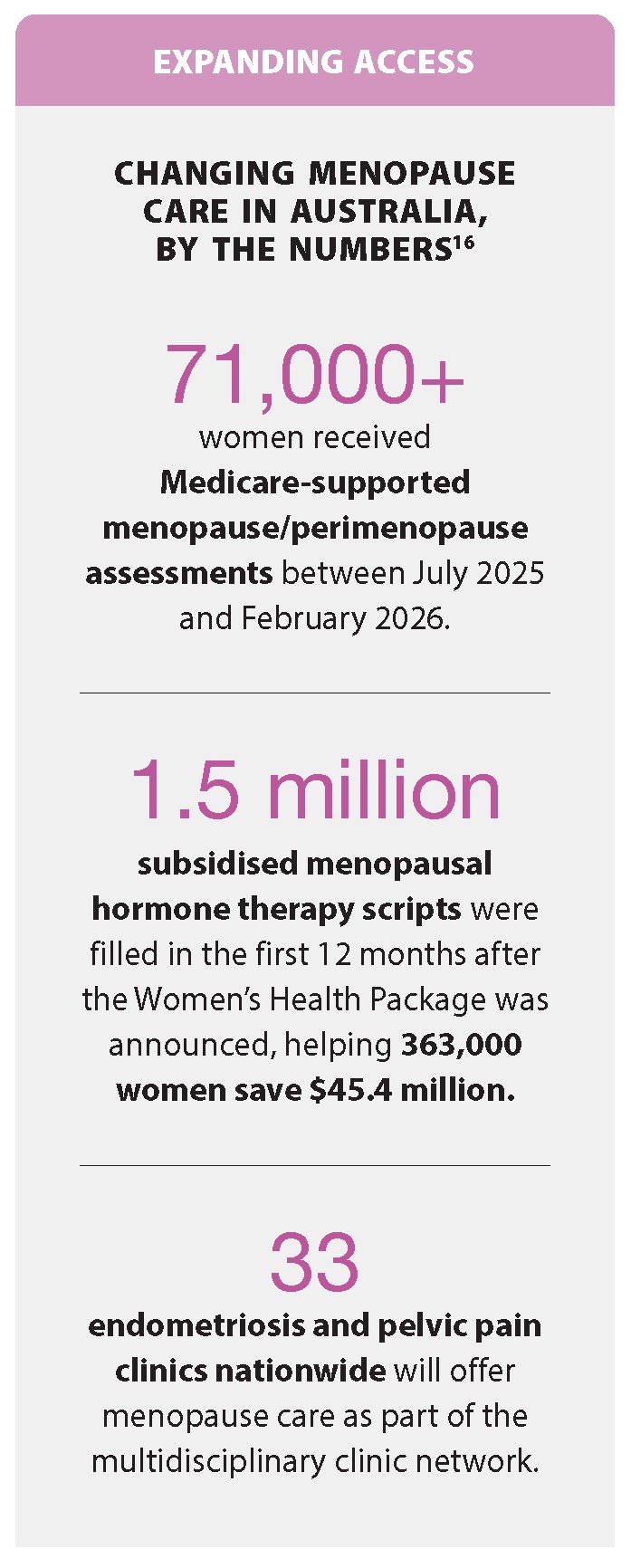
The government responded in 2025 with a $792.9 million Women’s Health Package, introducing Medicare rebates for menopause and perimenopause assessments, funding clinician training and national clinical guidelines, and the first Pharmaceutical Benefits Scheme (PBS) listings of new menopausal hormone therapies in more than 20 years, significantly reducing out-of-pocket costs.16
In February 2026, the government announced additional measures under the Women’s Health Package to expand menopause and perimenopause care through the national network of endometriosis and pelvic pain clinics and increase access to subsidised hormone therapies.16
Supply under pressureOngoing shortages of transdermal menopausal hormone therapy (MHT) patches – affecting Estradot, Estraderm MX and Estalis brands – have been a feature of Australian menopause care for more than 2 years, with manufacturers Sandoz and Juno citing constraints affecting supply through 2026. Climara was also discontinued at the end of 2023.10 Pharmacists can recommend alternatives using the Serious Scarcity Substitution Instrument (SSSI), which permits substitution between approved equivalents without prescriber authority.11 However, the SSSI has limitations: it applies only within specific equivalence categories and does not authorise all substitutions a pharmacist might consider clinically appropriate. Section 19A approvals for medicines not listed on the Australian Register of Therapeutic Goods,12 including overseas-registered alternatives such as Estramon, have plugged some gaps, but add their own complexities: patients switching to Section 19A products may encounter unfamiliar formulations, different dosing instructions and, in some cases, resistance to the change, requiring additional counselling to support continuity of care. Many women are facing the frustration of having to navigate unfamiliar territory, including the risk of symptom rebound or underdosing when switching their regular medicines. So careful guidance is needed to support confidence and continuity of care. The Australasian Menopause Society resource on low-, moderate- and high-dose equivalence has become a key pharmacist substitution tool.13 The Therapeutic Goods Administration is asking prescribers to hold off on new transdermal initiations to preserve supply for existing patients.14 |
Returning to evidence
It will take time to unravel a 20-year silence. Social media has stepped into this space, and misinformation now sits alongside underdiagnosis as one of the biggest barriers for patients, says Jarrah Anderson from MedCast, a clinical-education service that develops resources for prescribers and consumers.
‘There’s enormous misinformation, lots of influencers and confusion about evidence-based care,’ he says. Online hype around testosterone is an example, Mr Anderson says. The hormone is widely promoted online for a range of menopausal symptoms but is only indicated in Australia for hypoactive sexual desire disorder. However, there have been numerous claims made on social media that testosterone can improve energy, mood, cognitive function and weight management in menopausal women – none of which are currently supported by evidence sufficient for regulatory approval.17
Professor Davis, who has done 30-odd clinical trials on testosterone, says: ‘Studies show testosterone can modestly improve libido and arousal in women who are distressed by low sexual desire, but the effects are modest, and it hasn’t been shown to help anything else.’
Dr McGuire says that pharmacists are at the frontline of these conversations, often encountering women navigating confusion or misinformation. Many of these women come in seeking over-the-counter remedies and may not yet identify their symptoms as menopause-related. Sometimes they want to talk to pharmacists about natural alternatives that they think are the safer choice without seeking other professional support, with complementary medicines such as black cohosh, red clover isoflavones and evening primrose oil commonly requested. Vitamin E is the only supplement that has some evidence for its efficacy to reduce the number of hot flushes by 1–2 per day.18 It is frequently pharmacists who join the dots and open the door to a more informed conversation or a menopause assessment.
Confident conversations
Fortunately, conversations in communities will be increasingly supported by more evidence-based resources. Mr Anderson points to existing resources such as the Australasian Menopause Society’s Practitioner Directory, Symptoms Score Card and traffic-light guide to complementary medicines, which rates products green, amber or red according to the strength of evidence.18
Newer resources include a concise, evidence-based decision aid developed by Australia’s Quality Use of Medicines Alliance, Jean Hailes, MedCast and PSA. The aid helps women decide whether to start MHT, compare hormonal and non-hormonal options, and arrive at GP appointments prepared with informed questions. A companion clinical guide also supports prescribers, walking them through diagnosis, MHT initiation, dose selection and key contraindications.
More pharmacist-specific support is also emerging. The PSA is in the process of developing a menopause quick-reference guide to assist with counselling and substitution decisions. But resources are not enough. Academics were rightly criticised by the 2024 federal inquiry for omitting menopause from education, Dr McGuire says, and funding has been directed to reinstate it – but demand is rising faster than workforce capacity.
Also, there has not yet been population-wide ‘pollination’ of newer menopause evidence, she says, and progress is largely driven by already-interested clinicians, often in major cities, while confusion caused by persistent MHT supply shortages isn’t helping.
Increased opportunities for education are a must, says Dr McGuire. Women are 50% of the population, and they are often at an incredibly busy time of life in perimenopause and menopause. Without confident guidance, it’s still very easy for them to brush off their experience or overestimate risk and miss out on effective care. In the end, says Dr McGuire, ‘Why should women feel confident if health professionals aren’t?’
Finding the right careIt took 12 months, four GPs, one specialist and two investigations before Perth hospital pharmacist Bo Youn Kim, then in her early 40s, received menopausal hormone therapy (MHT). Heart palpitations sent her to a cardiologist who offered beta blockers; the first GP told her she was depressed and referred her to a psychologist. She was yelling at her children and her sleep was broken. She was drinking more. ‘I had stopped recognising myself,’ she says. Because she was hurting herself more on the soccer field, a friend suggested menopause. After little else helped, Bo finally suggested MHT to a doctor. When MHT was prescribed, the change was quick. ‘It saved my relationship with my kids and my husband,’ Ms Kim says. Later she thought, ‘If it takes me this long as a pharmacist [to receive menopause treatment], what options do other women have?’ Ms Kim, who now offers one-on-one menopause consultations, says many women cry at their first appointment – often, she suspects, because they are being properly heard for the first time. In many cases, Ms Kim says women underreport their symptoms, so she goes through the Australasian Menopause Society Symptom Score Card with them, sometimes for a second time. She sends women back to their GP with a quantified assessment and tailored recommendations. ‘They feel empowered, and GPs are usually receptive,’ she says. Sometimes, broad interpretations of risk have made it hard for her clients to access treatment, she adds. Researchers have argued, for example, that the long-standing rule limiting MHT initiation to within 10 years of menopause or before age 60 has itself become a barrier to care for some women in the 60-plus group. While this timeframe reflects a general risk pattern, MHT decisions should still be individualised based on the woman’s symptoms, age and overall risk profile. In many cases, Ms Kim coaches women to ask their clinician: ‘Are you treating the number, or the patient in front of you?’ If MHT is prescribed, she adds, the support work continues in pharmacies and doctors’ offices, as finding the dosing ‘sweet spot’ can take 6–12 months of adjustment. |
References
- Rossouw JE, Anderson GL, Prentice RL, et al.; Writing Group for the Women’s Health Initiative Investigators. Risks and benefits of estrogen plus progestin in healthy postmenopausal women: principal results from the Women’s Health Initiative randomized controlled trial. JAMA 2002;288(3):321–333.
- Manson JE, Aragaki AK, Rossouw JE, et al.; WHI Investigators. Menopausal hormone therapy and long-term all-cause and cause-specific mortality: the Women’s Health Initiative randomized trials. JAMA 2017;318(10):927–938.
- Mishra GD, et al. International Collaboration for a Life Course Approach to Reproductive Health and Chronic Disease Events (InterLACE). Brisbane: School of Public Health, University of Queensland. At: https://public-health.uq.edu.au/interlace
- NHS Business Services Authority. Hormone replacement therapy – England – April 2015 to June 2023. Newcastle upon Tyne: NHSBSA Statistics and Data Science. 2023.
- Risni HW, Brauer R, et al. Trends in government-subsidised menopausal hormone therapy dispensing in Australia between 2014 and 2023. Aust N Z J Obstet Gynaecol 2026;66(2):e70135.
- Islam RM, Bond M, Ghalebeigi A, et al. Prevalence and severity of symptoms across the menopause transition: cross-sectional findings from the Australian Women’s Midlife Years (AMY) Study. Lancet Diabetes Endocrinol 2025;13(9):765–776.
- Duncan A, Hailemariam A, Salazar S, et al.; Bankwest Curtin Economics Centre. The costs and benefits of implementing a universal reproductive health leave entitlement in Australia. Perth: Curtin University. 2025.
- Australasian Menopause Society, Women’s Health Research Program (Monash University), Jean Hailes for Women’s Health. The impact of symptoms attributed to menopause by Australian women: a report from the 2023 National Women’s Health Survey. Melbourne: Jean Hailes for Women’s Health. 2023.
- Senate Community Affairs References Committee. Issues related to menopause and perimenopause. Canberra: Parliament of Australia. 2024.
- Therapeutic Goods Administration. About the shortage of transdermal HRT patches. Canberra: TGA. 2024. At: https://www.tga.gov.au/safety/shortages-and-supply-disruptions/medicine-shortages/major-or-ongoing-medicine-shortages/about-shortage-transdermal-hrt-patches
- Therapeutic Goods Administration. Substitution approval extended for HRT patch shortages. Canberra: TGA. 2026. At: https://www.tga.gov.au/safety/shortages-and-supply-disruptions/medicine-shortages/medicine-shortage-alerts/substitution-approval-extended-hrt-patch-shortages
- Therapeutic Goods Administration. Section 19A approvals database. Canberra: TGA. At: https://www.tga.gov.au/resources/section-19a-approvals
- Australasian Menopause Society. AMS guide to MHT/HRT doses – Australia. AMS Hub. At: https://hub.menopause.org.au/Play?pId=6ecead60-db26-4dfc-a662-794d7b39ef59
- Therapeutic Goods Administration. About the shortage of transdermal HRT patches: information for prescribers. Canberra: TGA. 2024. At: https://www.tga.gov.au/safety/shortages-and-supply-disruptions/medicine-shortages/major-or-ongoing-medicine-shortages/about-shortage-transdermal-hrt-patches#information-for-prescribers
- Australian Government Department of Health and Aged Care. Government response to inquiry – issues related to menopause and perimenopause. Canberra: Australian Government. 2025. At: https://www.health.gov.au/resources/publications/government-response-to-inquiry-issues-related-to-menopause-and-perimenopause
- Butler M, White R. Women’s health package delivers [media release]. Canberra: Australian Government Department of Health and Aged Care. 2026. At: https://www.health.gov.au/ministers/the-hon-mark-butler-mp/media/womens-health-package-delivers
- Australasian Menopause Society. Testosterone therapy in postmenopausal women: evidence, efficacy, and safety. AMS Hub. At: https://hub.menopause.org.au/Play?pId=30177c59-b317-416c-bb2c-b4553114983e
- Australasian Menopause Society. Complementary medicines and therapies: options for menopausal symptoms. AMS Hub. At: https://hub.menopause.org.au/Play?pId=3234710f-e5db-4aa1-bff8-ae98449fffad