







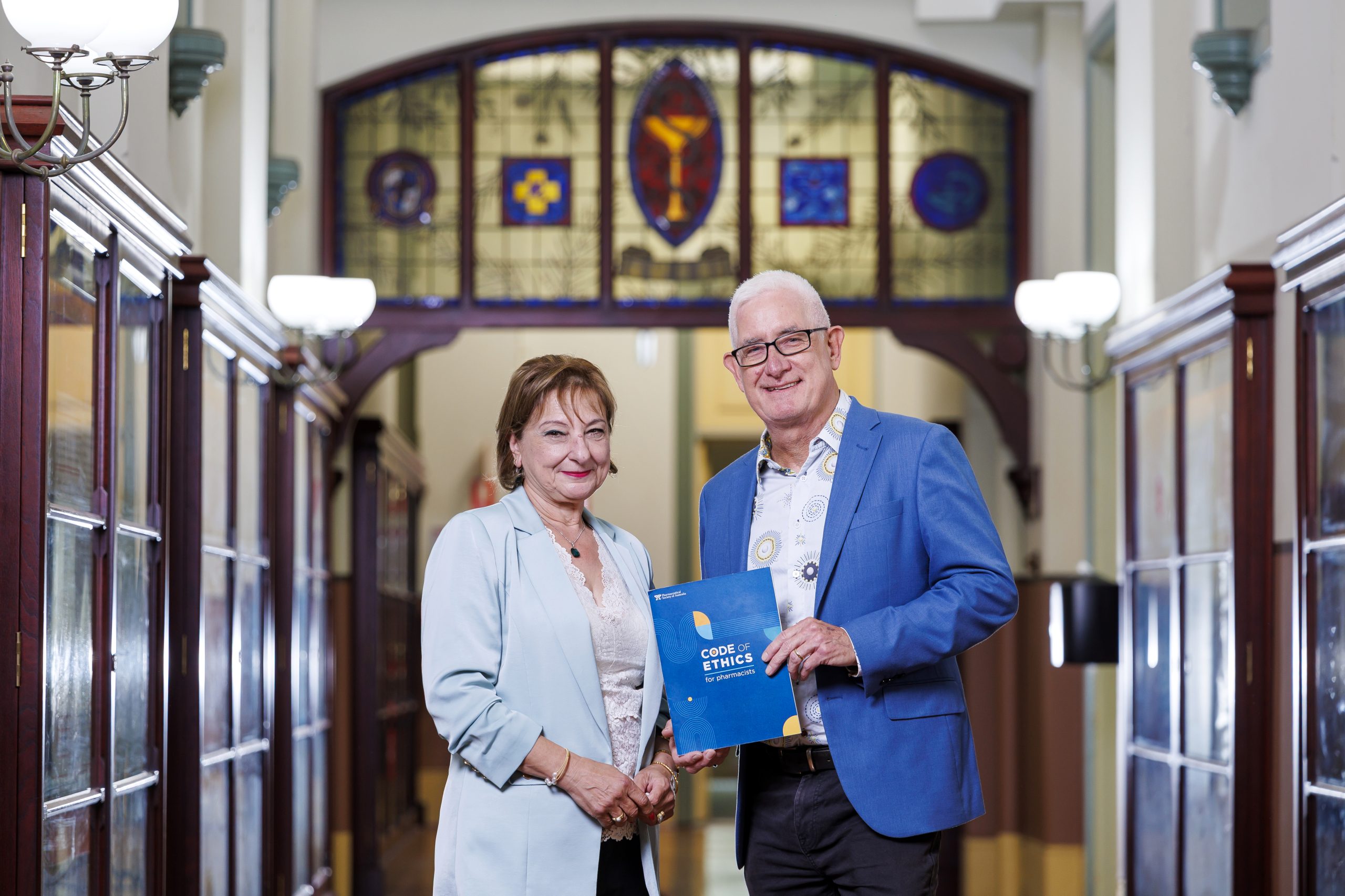
Nearly a decade after the last revision, PSA’s 2026 Code of Ethics for Pharmacists is designed to help pharmacists navigate a more complex profession – and the ethical dilemmas that come with it.
A pharmacist prescribes a medicine they also dispense. Another uses artificial intelligence to support a clinical decision. A third is deciding whether to manage a patient themselves or refer them elsewhere.
These are the type of scenarios pharmacists are increasingly expected to navigate. They are situations that would have looked very different when the last PSA Code of Ethics was published in 2017.
At that point, pharmacist prescribing was still years away, AI was barely part of the health care conversation and the first pharmacists were being embedded in GP clinics. Since then, the profession has expanded into new clinical roles, embraced digital health technologies and emerged from a pandemic that reshaped both public expectations and pharmacy practice itself. This evolution has created opportunities – but also new ethical questions. The 2026 Code of Ethics for Pharmacists is designed to help pharmacists answer them.¹
The release of the revised Code is timely. Later this year, the International Pharmaceutical Federation (FIP) is expected to release a position statement on developing codes of ethics, placing renewed focus on how the profession defines and maintains ethical standards in rapidly changing environments.
‘We’ve come a long way in the last few years,’ says Professor Betty Chaar, Chair of FIP’s Ethics Expert Group, Professor of Professional Ethics in Pharmacy at the University of Sydney and a member of the Code writing group.
‘It’s an amazing evolution of the profession of which we should be proud. Now, we need to maintain our ethical standards so we can grow further.’
Who pharmacists are
Unlike professional practice standards, which focus on what pharmacists do, the Code of Ethics for Pharmacists speaks to who pharmacists are. It sets out the behaviours and responsibilities expected of pharmacists, regardless of their practice setting, role or career stage.
And it is much more than a compliance document, says Professor Andrew McLachlan FPS, Dean of Pharmacy at the University of Sydney. ‘The Code of Ethics is the foundation on which everything else is built. It sets out the values we have as a profession that we should hold ourselves to.’
Yet despite the Code’s importance, many pharmacists rarely revisit it after graduating – unless a professional issue arises. Earlier this year, FIP President Paul Sinclair AM MPS reflected on a worrying pattern he had observed during his time reviewing complaints and regulatory matters with the Pharmacy Council of NSW.
In a number of cases, pharmacists showed ‘relatively little engagement with ethics in day-to-day practice’. Some, he wrote, were not aware there was a Code of Ethics at all.²
Ethical decision-making is a skill that requires active development. Not engaging with the Code can lead to blind spots, poor judgement calls and practice errors that affect patient safety.
‘Maintaining competence in ethics and legislation is not an additional burden,’ Mr Sinclair wrote. ‘It is part of maintaining the standard of practice that our patients and the community expect.’
For Dr Ayomide Ogundipe MPS, Chair of the Project Advisory Group, encouraging pharmacists to engage more actively with ethics was a central goal of the updated Code.
‘I hope pharmacists see it as a practical tool for navigating the complexity of modern practice, not just as a document that sits on a shelf,’ she says. ‘Ethics is not abstract. It shows up in everyday decisions: how we manage conflicts of interest, how we communicate with patients, when we refer, how we support colleagues, how we use professional judgement and how we respond when the environment around us makes practice difficult.’

Collaboration takes centre stage
The revised Code is built around four domains: Care, Integrity, Competency and – for the first time – Collaboration.
‘The inclusion of a Collaboration domain reflects the reality of contemporary pharmacy practice,’ says Dr Ogundipe. ‘Pharmacists are no longer working in isolation.’
Good collaboration, she says, isn’t just ‘getting along’ with other health professionals. Rather, it’s about ‘working in partnership to support safe, timely and coordinated care, and ensuring that the patient doesn’t fall through the gaps’.
Prof Chaar agrees. ‘We’ve always encouraged collaboration, but it’s even more meaningful now. We can’t encourage working in silos any longer. It’s unsustainable. We have to work as teams.’
The Code also emphasises the importance of referral, specifically pharmacists recognising when a patient’s needs are beyond their scope. ‘Referral is a really important ethical issue because it sits at the intersection of professional judgement, patient safety and humility,’ Dr Ogundipe says.
‘Pharmacists should see referral not as a failure to provide care, but as part of providing good care. The ethical obligation is not simply to say, “You should see someone else.” It is to take reasonable steps to help the person reach the right care.’
What does it mean to be ethical?
Laws, regulations and professional standards can tell pharmacists what they must or must not do. A code of ethics helps answer a different question: what is the right thing to do when the answer is not obvious?
For Prof Betty Chaar, ethics sits at the heart of the relationship between pharmacists and the community. ‘The public come in off the street, ask a pharmacist all sorts of questions and come away with advice and counselling and care,’ she says. ‘That trust is everything.’
A code of ethics helps protect that trust by giving pharmacists a shared set of values to guide decision-making – whether they are managing a conflict of interest, supporting a colleague or navigating a difficult patient interaction.
It doesn’t provide an answer for every situation. Instead, it helps pharmacists make decisions they can explain, justify and stand behind. ‘Without this foundation, we can’t function,’ Prof Chaar says.
‘We’ve always encouraged collaboration, but it’s even more meaningful now. We can’t encourage working in silos any longer. It’s unsustainable. We have to work as teams.’
Prof Betty Chaar
Staying accountable
Another major theme in the revised Code is accountability. That includes strengthened obligations around prescribing, dispensing and self-administration. For example, pharmacists should not dispense medicines prescribed for their own use
unless no reasonable alternative exists, and should not self-administer Schedule 4 or Schedule 8 medicines intended to be administered or witnessed by another qualified health professional.
Managing conflicts of interest and maintaining professional independence is also highlighted. ‘Pharmacists have an ethical obligation to preserve their professional judgement and ensure the patient’s interests remain central,’ says Dr Ogundipe. ‘The issue is not that commercial relationships exist. The issue is whether they compromise, or are perceived to compromise, the pharmacist’s primary obligation to the patient and the quality use of medicines.’
Prof McLachlan says the Code can also be a protection against accusations of conflict of interest. ‘When it’s said that pharmacists have a unique conflict because they can recommend, prescribe and dispense a medicine, we can point to the values within the Code of Ethics, which we use to make sure a decision is in the best interests of a patient, and not just about the commercial opportunity,’ he says.
There’s also a need for accountability in digital health and AI-enabled practice, with the Code reinforcing that responsibility for professional decisions remains with the pharmacist.
‘The revised Code reaffirms the view that pharmacists are responsible for the health outcomes of their patients,’ says Dr Will Olsen MPS, who was part of the Code writing group. ‘While it can be difficult sometimes, recognising this responsibility is essential to acting in the best interests of patients even in complex and difficult situations. This is an important professional value in a time of change like the profession is experiencing now.’

Wellbeing is now an ethical obligation
For the first time, pharmacist wellbeing has been recognised as an ethical obligation, reflecting concerns about burnout, workload pressures and workforce sustainability.
‘The inclusion of wellbeing recognises that pharmacists cannot provide safe, compassionate and effective care if they are working in environments or conditions that consistently undermine their own health, safety or professional judgement,’ Dr Ogundipe says.
‘I hope pharmacists see it as a practical tool for navigating the complexity of modern practice, not just as a document that sits on a shelf.’
Dr Ayomide Ogundipe MPS
Wellbeing isn’t only important for pharmacists, but for patient-centred care, Prof Chaar says. ‘If you have a pharmacist who is calm and collected, not frazzled, not overworked, not burnt out – you get much better care for the patient.’
Importantly, the Code goes beyond individual self-care, addressing workplace culture, psychological safety, professional autonomy and support for colleagues. For pharmacists in leadership roles, there is an obligation to support more junior colleagues.
‘This support is now clearly framed as an ethical responsibility, not just a nice thing to do,’ Dr Ogundipe says.
‘It reflects the reality that safe practice depends on culture, supervision and support, not just individual competence.
‘I hope this helps shift the conversation away from wellbeing as optional or personal, and towards wellbeing being understood as fundamental to safe and ethical pharmacy practice.’
From principles to practice
A code of ethics can only take pharmacists so far. The real challenge comes from applying it. To help implement the Code, PSA has developed the GUIDE ethical decision-making framework3 alongside a suite of case studies.
‘The framework involves reviewing the facts, identifying the ethical issues, considering the options and implications, choosing an option and being able to defend and justify that choice,’ Prof Chaar says. ‘These are the steps we’re trying to train people in, because it needs to become second nature.’
For Dr Olsen, the value of GUIDE lies in slowing decision-making down.
‘Ethical decision-making is hard and these decisions shouldn’t be automatic or based on intuition,’ he says. ‘A key feature of the framework is that it slows down decision-making so that the pharmacist using it considers all relevant aspects and potential unintended consequences of their actions when making challenging decisions.’
One case study explores conscientious objection. In the scenario, a pharmacist’s personal beliefs come into conflict with their duty of care to a patient. Rather than treating the issue as an all-or-nothing choice, the GUIDE framework encourages pharmacists to consider options that balance both obligations. For example, the possibility of a roster of non-objecting pharmacists, allowing access to care while respecting the pharmacist’s right to conscientious objection.
‘This case is illustrative of the way that the GUIDE framework facilitates consideration of numerous aspects of a problem and relevant advice to support a defensible judgement as an outcome,’ Dr Olsen says. ‘In this case, the justification rests on coherence with ethical, legal and professional advice.’
The case studies were intentionally developed around contemporary practice challenges, including areas where the revised Code introduces new or strengthened guidance. Rather than providing definitive answers, they demonstrate how ethical reasoning can be applied to real-world situations.
As pharmacy practice continues to evolve, new technologies, expanded scope and changing models of care will inevitably create ethical questions that today’s Code cannot specifically anticipate. But the principles are designed to endure.
‘Social norms change but the principles of healthcare don’t change that much,’ Prof Chaar says.
Ultimately, it comes back to trust. ‘The values of the profession make us what we are,’ Prof Chaar says. ‘The public trusts us. We need to nurture that trust, and maintain our strong foundation of patient-centred care.’
The Code of Ethics through the years
- 2011 Building an ethical foundation
The 2011 Code marked a significant shift for Australian pharmacy. According to Professor Betty Chaar, it moved beyond earlier approaches that focused largely on professional etiquette and conduct towards a framework grounded in healthcare ethics and patient-centred care.
‘It was the beginning of us as pharmacists being engaged in bioethics,’ she says. The Code established the principles-based approach that continues to underpin pharmacy ethics today.
- 2017 Refining the framework
The 2017 revision strengthened and updated the existing Code rather than fundamentally changing its direction. Patient-centred care, integrity and professional competency remained at its core as pharmacists took on increasingly clinical roles, including vaccination services and expanded medicines management responsibilities.
- 2026 Ethics for a changing profession
The latest revision comes after one of the most transformative periods in pharmacy’s history. COVID-19, pharmacist prescribing, digital health technologies and a seemingly ever-evolving scope have reshaped practice. The 2026 Code introduces a standalone Collaboration domain, formalises pharmacist wellbeing as an ethical obligation, and strengthens guidance around accountability, professional independence and conflicts of interest.
As Prof Chaar puts it: ‘We are continuing to build on our foundations. We’re building, emphasising, strengthening, clarifying.’
References
- Pharmaceutical Society of Australia. Code of Ethics for Pharmacists. 2026. At: https://www.psa.org.au/practice-support-industry/ethics/
- Sinclair P. A question of ethics: FIP President calls for annual review. Australian Pharmacist. 2026. At: https://www.australianpharmacist.com.au/fip-president-calls-for-annual-ethics-review/
- Pharmaceutical Society of Australia. GUIDE Framework: ethical decision-making tool for pharmacists. 2026. At: https://www.psa.org.au/wp-content/uploads/2026/06/G.U.I.D.E-Framework.pdf