







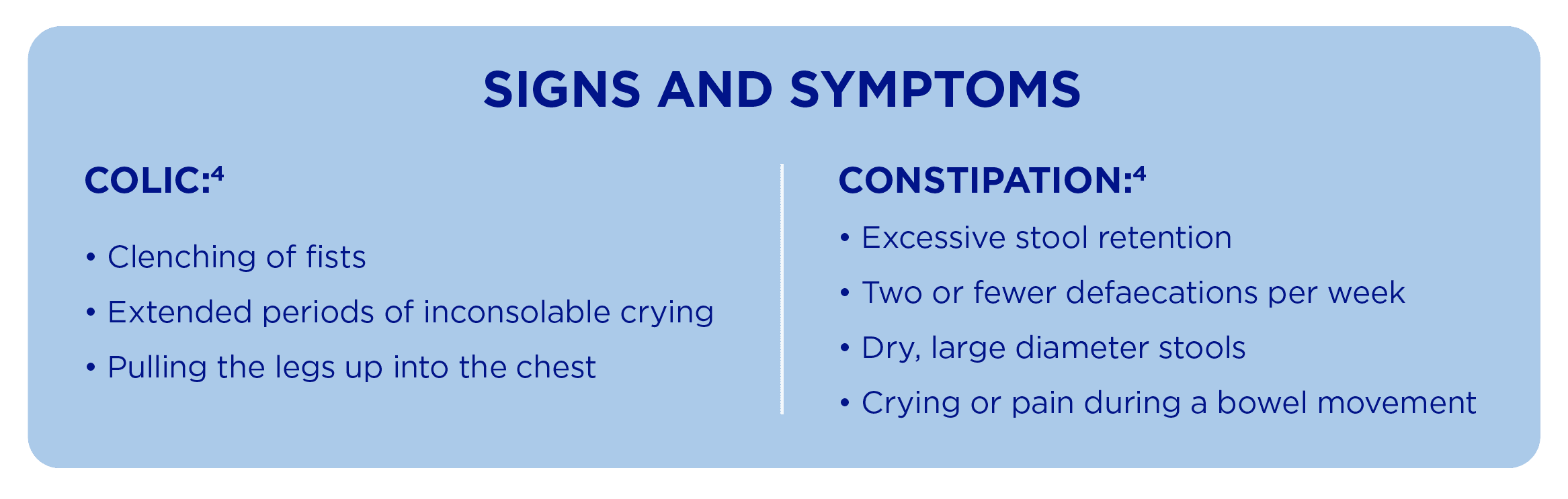
Colic (periods of prolonged, intensive, inconsolable crying in an otherwise healthy infant) or constipation are common functional gastrointestinal disorders in early childhood, and they are experienced by up to one in three infants.1-4
Help parents to learn about common signs and symptoms of colic and constipation in early childhood.
Impacts of colic and constipation on quality of life

Nutritional management of infantile colic and constipation
Experts now recognise first-line management should focus on parental reassurance and a nutrition first approach.4 During episodes of colic or constipation, breastfeeding should be maintained as the primary feeding whenever possible, with the introduction of formula use reserved to situations where breastfeeding is not feasible or insufficient.4 A partially hydrolysed formula with reduced lactose and containing prebiotics or probiotics may contribute to a reduction in crying time.4Aptamil Colic & Constipation is an infant formula designed for the dietary management of functional gastrointestinal disorders such as colic and constipation.
Aptamil Colic & Constipation improved infant and family quality of life5
Symptom improvement reported by parents in 24 hours*6
 Aptamil Colic & Constipation contains…
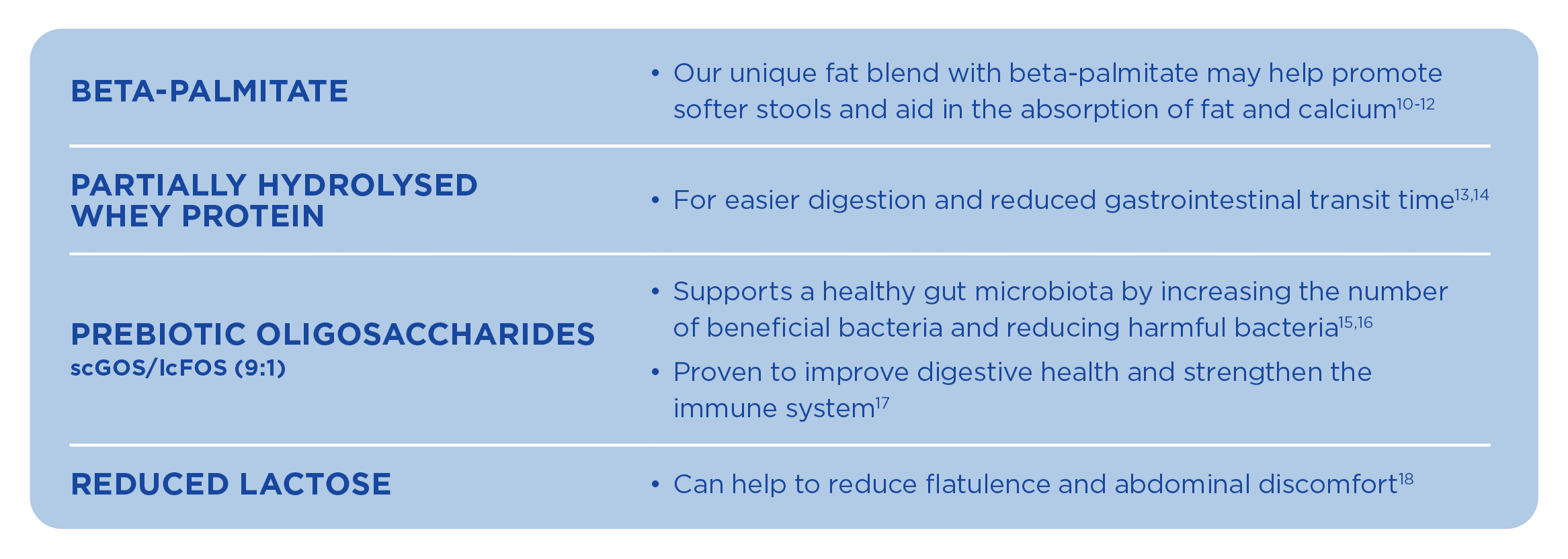
It’s our proven science that sets us apart † 17
Nutritionally supporting families managing colic and constipation with Aptamil
Find out more about our science
*Survey conducted among parents of infants with mild digestive disorders consuming Aptamil Colic & Constipation (n=29) – Spain, Sep 2022.
†Prebiotic blend as scGOS/lcFOS in the ratio 9:1. This disclaimer applies to all Aptamil products formulates with this prebiotic blend.
FOR HEALTHCARE PROFESSIONAL USE ONLY. Not for distribution to the general public. The information in this document is general only. Healthcare professionals should rely on their own skill and judgement when assessing and diagnosing patients.
IMPORTANT NOTICE: BREAST MILK IS BEST FOR BABIES:
Breastfeeding is the best for babies, and a healthy diet is important when breastfeeding. A decision not to breastfeed can be difficult to reverse. Infant formula is suitable from birth when babies are not breastfed. It is recommended that all formula milks be used on the advice of a doctor, midwife, health visitor, public health nurse, dietitian, pharmacist, or other professional responsible for maternal and childcare and the social and financial implications should be considered. All preparation and feeding instructions should be followed carefully as inappropriate preparation could lead to health hazards.
FIND OUT MORE ABOUT APTAMIL
Request a sample for professional Evaluation
Visit our website to learn more.
References
- Vandenplas Y, et al. J Pediatr Gastroenterol Nutr 2015;61:531–537.
- Vandenplas Y, et al. Pediatr Gastroenterol Hepatol Nutr 2019;22:207–216.
- Iacono G, et al. Dig Liver Dis 2005;37:432–438.
- Salvatore S, et al. Acta Paediatr 2018;107:1512–1520.
- Carosella MV, et al. Poster presented at: 57th Annual Meeting of ESPGHAN; 2025; Helsinki, Finland.
- Data on file. 2022.
- Savino F, et al. Eur J Clin Nutr. 2006;60:1304–10.
- Schmelzle H, et al. J Pediatr Gastroenterol Nutr 2003;36:343–351.
- Savino F, et al. Acta Paediatr Suppl 2005;94:120–124.
- Havlicekova Z, et al. Nutr J. 2015;15(1):28.
- Carnielli VP, et al. Am J Clin Nutr. 1995;61(5):1037-42.
- Kennedy K, et al. Am J Clin Nutr. 1999;70(5):920-7.
- Billeaud C, et al. Eur J Clin Nutr. 1990;44(8):577-83.
- Tolia V, et al. J Pediatr Gastroenterol Nutr. 1992;15(3):297-301.
- Knol J, et al. Acta Paediatr Suppl. 2005;94(449):31-3.
- Moro G, et al. J Pediatr Gastroenterol Nutr. 2002;34(3):291-5.
- Blumfield M, et al. Nutr Soc Aust. 2025. Abstract 129750.
- Kanabar D, et al. J Hum Nutr Diet. 2001;14(5):359-63.